
Higher education can be a valuable investment in your future, but the cost of tuition, accommodation, books, and other expenses can be significant. An education loan helps students finance their studies without placing the entire financial burden on their families.
Banks and financial institutions in India offer education loans for undergraduate, postgraduate, professional, vocational, and international study programs. The loan amount, interest rate, repayment terms, and eligibility vary depending on the lender and the course you choose.
This guide explains everything you need to know about education loans, including eligibility, expenses covered, interest rates, repayment, and tips to improve your chances of approval.
Quick Overview
| Particular | Details |
| Loan Type | Education Loan |
| Purpose | Higher Education in India & Abroad |
| Collateral | Depends on Loan Amount & Lender Policy |
| Co-Applicant | Usually Required |
| Moratorium Period | Generally Course Duration + Additional Time (Varies by Lender) |
| Repayment Tenure | Varies by Lender (Often Up to 15 Years or More) |
| Interest Rate | Depends on Lender, Course & Applicant Profile |
What is an Education Loan?
An education loan is a loan provided by a bank or financial institution to help students pay for higher education expenses.
The loan is usually taken jointly with a parent, guardian, spouse, or another eligible co-applicant, who shares the responsibility of repayment.
Education loans are available for:
- Undergraduate courses
- Postgraduate courses
- Professional courses
- Diploma programs
- Skill development courses
- Technical education
- Studies abroad (subject to lender policy)
Expenses Covered Under an Education Loan
Depending on the lender and the approved course, an education loan may cover:
- Tuition fees
- Admission fees
- Examination fees
- Hostel fees
- Library charges
- Laboratory fees
- Books and study materials
- Laptop (where permitted by lender)
- Travel expenses for overseas education (if applicable)
- Insurance premium (if required)
- Other approved academic expenses
Always check the lender’s loan agreement to understand exactly which expenses are covered.
Types of Education Loans
- Domestic Education Loan
For students pursuing higher education within India.
Suitable for:
- Engineering
- Medical
- Management
- Law
- Arts
- Science
- Commerce
- Other recognized courses
- Overseas Education Loan
For students studying abroad.
Common destinations include:
- USA
- Canada
- United Kingdom
- Australia
- Germany
- Ireland
- Singapore
- Other approved countries
These loans may also cover eligible travel and living expenses, subject to lender policy.
Education Loan Eligibility
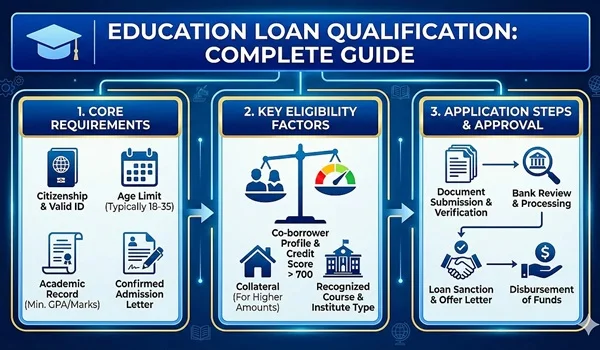
Eligibility varies between lenders, but common requirements include:
- Indian citizen (for most domestic loan schemes)
- Confirmed admission to a recognized educational institution
- Eligible course approved by the lender
- Co-applicant with acceptable financial profile
- Satisfactory academic record (as required by the lender)
For overseas education, additional eligibility conditions may apply.
Who Can Be a Co-Applicant?
Most lenders require a co-applicant such as:
- Parent
- Legal guardian
- Spouse
- Sibling (in some cases)
- Other eligible family member (subject to lender policy)
The lender evaluates the co-applicant’s income and repayment capacity before approving the loan.
Documents Required
Student Documents
- Aadhaar Card
- PAN Card (if applicable)
- Passport-size photographs
- Admission letter
- Fee structure
- Academic mark sheets
- Entrance exam scorecard (if required)
- Passport and visa (for overseas education)
Co-Applicant Documents
- Identity proof
- Address proof
- Income proof
- Salary slips or business income documents
- Bank statements
- Income Tax Returns (where applicable)
Collateral Documents (If Required)
For secured education loans, lenders may request:
- Property documents
- Fixed Deposit receipts
- Other eligible security documents
Requirements depend on the loan amount and lender policy.
Education Loan Interest Rates
Education loan interest rates depend on several factors, including:
- Lender
- Course
- Institution
- Loan amount
- Credit assessment
- Co-applicant’s financial profile
- Collateral (if applicable)
Some lenders also offer interest concessions for eligible students or female applicants under specific schemes.
Compare the Annual Percentage Rate (APR) and total borrowing cost instead of focusing only on the advertised interest rate.
Education Loan Repayment
Most education loans offer a moratorium period, during which repayment of the principal is deferred.
The moratorium generally includes:
- Course duration
- Plus an additional period after course completion (often 6–12 months, depending on the lender)
After the moratorium ends, regular EMIs begin.
Some lenders also allow voluntary interest payments during the study period.
Loan Amount
The maximum loan amount depends on factors such as:
- Course cost
- Institution
- Country of study
- Repayment capacity
- Collateral availability
- Lender policy
Some lenders have different limits for studies in India and abroad.
Secured vs Unsecured Education Loan
| Secured Education Loan | Unsecured Education Loan |
| Requires collateral | No collateral required |
| Higher loan amounts may be available | Loan amount may be lower |
| May offer lower interest rates | Interest rates may be higher |
| Suitable for expensive courses | Suitable for eligible students with strong profiles |
How to Apply for an Education Loan
Step 1
Research and compare multiple banks and NBFCs.
Step 2
Check eligibility criteria.
Step 3
Collect all required documents.
Step 4
Submit the application online or at the nearest branch.
Step 5
The lender verifies:
- Admission
- Course
- Documents
- Co-applicant profile
- Repayment capacity
Step 6
If approved, the lender issues a sanction letter and disburses the loan according to the institution’s fee schedule.
How to Improve Approval Chances
- Apply soon after receiving admission confirmation.
- Choose a recognized educational institution.
- Ensure your documents are complete.
- Maintain a financially stable co-applicant.
- Provide accurate information in the application.
- Compare lenders before applying.
Tax Benefits on Education Loans
Interest paid on an eligible education loan may qualify for tax deductions under Section 80E of the Income Tax Act, subject to applicable conditions and prevailing tax laws.
Since tax rules can change, verify the latest provisions before claiming deductions.
Common Mistakes to Avoid
- Applying without comparing lenders.
- Ignoring processing fees and other charges.
- Borrowing more than required.
- Missing document requirements.
- Not understanding the moratorium period.
- Failing to read the loan agreement carefully.
Education Loan vs Personal Loan
| Education Loan | Personal Loan |
| Specifically for education expenses | Can be used for various purposes |
| Usually offers a moratorium period | EMIs generally start soon after disbursement |
| May offer tax benefits on eligible interest payments | No specific education-related tax benefit |
| Designed for students | Based on applicant’s income and eligibility |
Frequently Asked Questions (FAQs)
Who is eligible for an education loan?
Students admitted to eligible courses at recognized institutions, along with a qualifying co-applicant, may be eligible. Exact requirements vary by lender.
Is collateral required for an education loan?
Not always. Smaller loans may be available without collateral, while larger loan amounts may require security depending on the lender’s policy.
Can I get an education loan for studying abroad?
Yes. Many banks and NBFCs offer education loans for approved overseas institutions and courses, subject to their eligibility criteria.
When do I start repaying an education loan?
Repayment generally begins after the moratorium period ends, which usually includes the course duration plus an additional period specified by the lender.
Are education loans eligible for tax benefits?
Interest paid on eligible education loans may qualify for tax deductions under Section 80E, subject to applicable conditions under the Income Tax Act.
Final Thoughts
An education loan can make higher education more accessible by helping students finance tuition and related expenses without paying the full cost upfront. Choosing the right lender, understanding the repayment terms, and borrowing only what you need can make repayment more manageable after completing your studies.
Before applying, compare interest rates, processing fees, loan features, repayment flexibility, and eligibility criteria across multiple lenders. A well-planned education loan can support your academic goals while helping you build a strong financial foundation for the future.






Leave a Reply