
Starting a business is a major financial decision, and one of the first questions many aspiring entrepreneurs ask is: Should I buy a franchise or start my own business? Both options have the potential to generate profits, but they differ significantly in terms of investment, risk, control, branding, operational flexibility, and long-term growth.
A franchise allows you to operate under an established brand with a proven business model, while an independent business gives you complete ownership and freedom to build your own brand from scratch.
If you’re unsure which option is right for you, this guide compares Franchise vs Own Business across all important factors to help you make an informed decision.
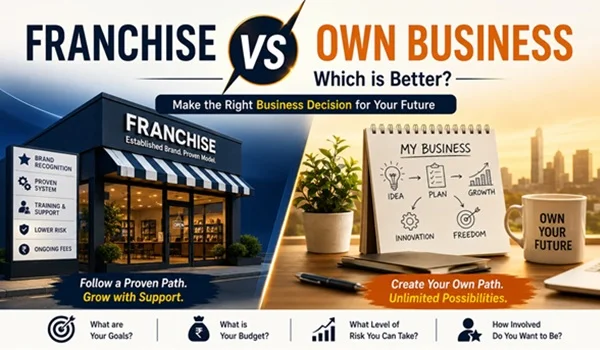
Quick Comparison: Franchise vs Own Business
| Feature | Franchise Business | Own Business |
| Brand Recognition | Established Brand | Build Your Own Brand |
| Initial Investment | Usually Higher | Flexible |
| Business Model | Proven System | Create Your Own |
| Royalty Fees | Usually Applicable | No Royalty |
| Business Control | Limited | Complete Control |
| Marketing Support | Provided by Franchisor | Self-Managed |
| Training | Usually Provided | Self-Learning |
| Risk Level | Moderate | Depends on Business |
| Growth Flexibility | Limited by Franchise Rules | Unlimited |
| Best For | Beginners | Entrepreneurs & Innovators |
What is a Franchise Business?
A franchise business is a model where an entrepreneur (franchisee) purchases the right to operate under an established company’s brand, business system, and operating guidelines.
The franchisor generally provides:
- Brand name
- Business model
- Training
- Marketing support
- Operating procedures
- Product sourcing guidance
In return, the franchisee typically pays an initial franchise fee and, in many cases, ongoing royalty or marketing fees.
Examples of industries offering franchise opportunities include:
- Food & Beverage
- Retail
- Education
- Fitness
- Healthcare
- Courier Services
- Automobile Services
What is an Own Business?
An own business (independent business) is one that you start and manage under your own brand.
You decide everything, including:
- Business name
- Products or services
- Pricing
- Marketing
- Suppliers
- Business strategy
- Expansion plans
There are no franchise agreements or royalty payments.
Franchise vs Own Business: Detailed Comparison
- Brand Recognition
Franchise
One of the biggest advantages of a franchise is instant brand recognition.
Customers already know and trust the brand, making it easier to attract initial customers.
Own Business
You’ll need to build your brand from the ground up through consistent quality, marketing, and customer service.
Winner: Franchise
- Initial Investment
Franchise businesses often require:
- Franchise fee
- Security deposit
- Interior setup
- Equipment
- Inventory
- Working capital
Some franchises may also require periodic marketing or royalty payments.
An independent business offers greater flexibility—you can start small and expand gradually based on your budget.
Winner: Own Business (for flexibility)
- Business Control
Franchise
You’ll generally need to follow the franchisor’s:
- Brand guidelines
- Pricing policies
- Product standards
- Store design
- Operating procedures
Own Business
You have complete freedom to make decisions regarding:
- Products
- Pricing
- Marketing
- Suppliers
- Business expansion
Winner: Own Business
- Training and Support
Most franchisors provide:
- Initial training
- Staff training
- Operations manuals
- Business support
- Marketing assistance
With your own business, you’ll need to learn and develop systems yourself.
Winner: Franchise
- Profit Sharing
In many franchise models, you may need to pay:
- Franchise fees
- Royalty charges
- Marketing contributions
An independent business allows you to retain all business profits after expenses.
Winner: Own Business
- Marketing
Franchise businesses often benefit from national or regional marketing campaigns run by the franchisor.
However, local marketing responsibilities may still rest with the franchisee.
Independent businesses must create and manage their own marketing strategy.
Winner: Franchise
- Business Risk
A franchise generally offers a proven operating model, which can reduce certain startup risks.
However, success is never guaranteed. Location, management, customer service, and market conditions still play a major role.
An independent business carries more uncertainty initially but also offers greater freedom to innovate.
Winner: Franchise (for beginners)
- Growth Opportunities
Franchise expansion depends on:
- Franchise policies
- Territory restrictions
- Approval from the franchisor
Independent businesses have complete flexibility to:
- Launch new products
- Open new branches
- Enter new markets
- Diversify operations
Winner: Own Business
- Creativity and Innovation
A franchise limits experimentation because you must follow established operating standards.
With your own business, you can:
- Introduce new products
- Change branding
- Test pricing
- Explore new business models
Winner: Own Business
- Exit Value
An independent business with a strong brand can become a valuable long-term asset that may attract buyers or investors.
The resale or transfer of a franchise business is generally governed by the franchise agreement and may require the franchisor’s approval.
Winner: Own Business
Advantages of a Franchise Business
- Established brand recognition
- Proven business model
- Training and operational support
- Marketing assistance
- Easier customer acquisition
- Standardized processes
Disadvantages of a Franchise Business
- Higher startup costs
- Royalty and recurring fees
- Limited business freedom
- Restricted product offerings
- Dependence on the franchisor’s policies and reputation
- Expansion may require approval
Advantages of Starting Your Own Business
- Complete ownership
- Full decision-making authority
- No royalty payments
- Unlimited growth potential
- Freedom to innovate
- Ability to build your own brand
- Flexible pricing and product selection
Disadvantages of Starting Your Own Business
- Brand building takes time
- No established customer base
- Greater responsibility
- Higher learning curve
- Marketing must be handled independently
Who Should Choose a Franchise?
A franchise may be suitable if you:
- Are a first-time entrepreneur
- Prefer a structured business model
- Want training and ongoing support
- Are comfortable following established systems
- Have the required investment
Who Should Start Their Own Business?
Starting your own business may be a better choice if you:
- Want complete independence
- Have a unique business idea
- Enjoy innovation
- Plan to build a long-term brand
- Prefer full control over profits and operations
Franchise vs Own Business: Which is More Profitable?
There is no universal answer.
A successful franchise can generate consistent profits thanks to brand recognition and proven systems, but recurring fees may reduce net earnings.
An independent business may take longer to become profitable, but you retain full ownership of the brand and profits. If it succeeds, the long-term financial rewards can be significantly greater.
Ultimately, profitability depends on factors such as:
- Market demand
- Business location
- Competition
- Customer service
- Cost management
- Marketing
- Operational efficiency
Common Mistakes to Avoid
- Choosing a franchise based only on brand popularity.
- Ignoring the franchise agreement and royalty structure.
- Starting a business without market research.
- Underestimating working capital requirements.
- Not preparing a detailed business plan.
- Focusing only on investment instead of long-term sustainability.
Frequently Asked Questions (FAQs)
Is a franchise better than starting your own business?
It depends on your goals. A franchise offers a proven system and brand support, while an independent business provides complete ownership, flexibility, and long-term brand-building opportunities.
Which business has less risk?
A franchise may reduce certain startup risks because of its established business model, but it does not eliminate business risk. Success still depends on execution, location, and market demand.
Do franchise businesses always pay royalty?
Many franchises charge royalty and marketing fees, but the structure varies by brand. Always review the franchise agreement carefully before investing.
Can I earn more from my own business?
Yes. Since there are generally no royalty payments and you own the brand, an independent business can offer greater long-term earning potential if it is managed successfully.
Which is better for beginners?
Many first-time entrepreneurs choose franchises because of the training and support provided. However, beginners with a strong business idea, market knowledge, and willingness to learn can also succeed with an independent business.
Final Thoughts
Both franchise businesses and independent businesses have their own advantages. If you value an established brand, operational guidance, and a structured system, a franchise can be a good starting point. On the other hand, if your goal is to build your own brand, enjoy complete business freedom, and maximize long-term growth, starting your own business may be the better option.
Before making a decision, carefully evaluate your budget, experience, risk tolerance, and long-term vision. Whichever path you choose, thorough market research, financial planning, and consistent customer service will play a much bigger role in your success than the business model itself.






Leave a Reply