
Choosing the right business structure is one of the first and most important decisions for any entrepreneur. Two of the most popular options for small businesses and startups in India are Sole Proprietorship and Limited Liability Partnership (LLP). While both structures allow you to run a business legally, they differ significantly in terms of ownership, liability, registration, taxation, compliance, and growth opportunities.
A sole proprietorship is ideal for individuals who want to start a business quickly with minimal paperwork, whereas an LLP provides a separate legal identity and limited liability protection, making it suitable for businesses planning long-term growth.
In this guide, we’ll compare Sole Proprietorship vs LLP in detail to help you choose the business structure that best fits your goals.
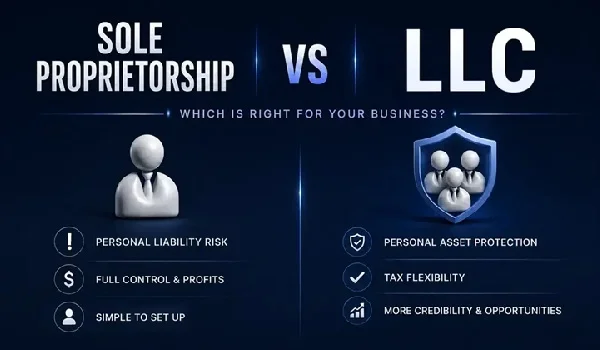
Quick Comparison: Sole Proprietorship vs LLP
| Feature | Sole Proprietorship | LLP (Limited Liability Partnership) |
| Ownership | One Owner | Minimum Two Partners |
| Legal Status | Not Separate from Owner | Separate Legal Entity |
| Liability | Unlimited | Limited to Partner’s Contribution |
| Registration | No Central Registration | Mandatory Registration with MCA |
| Compliance | Low | Moderate |
| Taxation | Taxed as Individual | Taxed as LLP |
| Business Continuity | Depends on Owner | Continues Regardless of Partner Changes |
| Fund Raising | Difficult | Easier than Proprietorship |
| Best For | Small Businesses & Freelancers | Growing Businesses & Startups |
What is a Sole Proprietorship?
A Sole Proprietorship is the simplest form of business where a single individual owns, manages, and controls the entire business.
The owner receives all profits but is also personally responsible for all debts and liabilities.
Examples include:
- Grocery shops
- Freelancers
- Consultants
- Small retail stores
- Home-based businesses
- Local service providers
There is no separate legal identity between the business and the owner.
What is an LLP?
A Limited Liability Partnership (LLP) is a business structure governed by the Limited Liability Partnership Act, 2008. It combines the flexibility of a partnership with the benefit of limited liability.
An LLP is considered a separate legal entity, meaning the business can own assets, enter contracts, and continue operating independently of its partners.
It requires at least two designated partners and must be registered with the Ministry of Corporate Affairs (MCA).
Difference Between Sole Proprietorship and LLP
- Ownership
Sole Proprietorship
Only one person owns and manages the business.
LLP
Requires at least two partners who jointly manage the business according to the LLP Agreement.
Winner: Depends on your business model.
- Legal Identity
A Sole Proprietorship has no separate legal identity. The owner and business are treated as the same entity.
An LLP has a separate legal identity, allowing it to own property, sue, and be sued in its own name.
Winner: LLP
- Liability Protection
This is one of the biggest differences.
Sole Proprietorship
The owner’s personal assets may be used to repay business debts if the business cannot meet its obligations.
LLP
Partners generally have limited liability, meaning their financial responsibility is usually limited to the agreed contribution, subject to applicable laws.
Winner: LLP
- Registration Process
Sole Proprietorship
There is no single central registration process.
Depending on the business type, owners may need:
- GST Registration
- Shop & Establishment License
- Udyam Registration
- Professional Tax Registration
- FSSAI License (if applicable)
LLP
Registration with the Ministry of Corporate Affairs is mandatory.
The process generally includes:
- Digital Signature Certificate (DSC)
- Director Identification Number (DIN), where applicable
- Name approval
- LLP Incorporation
- LLP Agreement filing
Winner: Sole Proprietorship (simpler setup)
- Compliance Requirements
Sole Proprietorship
Compliance is relatively simple.
Requirements depend on the nature of the business and applicable tax laws.
LLP
LLPs have additional compliance obligations, including:
- Annual filing with MCA
- Income tax filing
- Statement of accounts and solvency
- Other statutory filings, where applicable
Winner: Sole Proprietorship
- Taxation
Sole Proprietorship
Business income is taxed as part of the owner’s personal income according to the applicable income tax rules.
LLP
An LLP is taxed separately under the Income-tax Act.
Tax implications vary depending on business income and applicable laws.
Winner: Depends on your income level and tax planning requirements.
- Fund Raising
Banks and investors generally view LLPs as more structured business entities.
LLPs may find it comparatively easier to:
- Obtain business loans
- Enter strategic partnerships
- Build business credibility
However, LLPs cannot issue equity shares like private limited companies.
Winner: LLP
- Business Continuity
A Sole Proprietorship is closely linked to the owner’s existence and participation.
An LLP generally enjoys perpetual succession, allowing the business to continue even if partners change, subject to legal requirements.
Winner: LLP
- Business Credibility
LLPs often create greater confidence among:
- Corporate clients
- Vendors
- Banks
- Investors
- Government organizations
This can be beneficial when bidding for larger contracts.
Winner: LLP
Advantages of Sole Proprietorship
- Easy to start
- Minimal paperwork
- Low compliance costs
- Full control over business decisions
- Suitable for small businesses
- Simple accounting
Disadvantages of Sole Proprietorship
- Unlimited personal liability
- Limited funding options
- Business continuity depends on owner
- Lower credibility for larger commercial contracts
Advantages of LLP
- Limited liability protection
- Separate legal entity
- Better business credibility
- Easier expansion
- Perpetual succession
- Suitable for partnerships
Disadvantages of LLP
- More compliance requirements
- Registration process is more detailed
- Higher incorporation and maintenance costs than a sole proprietorship
- Requires at least two partners
Who Should Choose a Sole Proprietorship?
A Sole Proprietorship is generally suitable for:
- Freelancers
- Consultants
- Bloggers
- Content creators
- Small shop owners
- Home-based businesses
- Local service providers
It works well for businesses with relatively low risk and simple operations.
Who Should Choose an LLP?
An LLP may be more suitable for:
- Startups with multiple founders
- Professional firms
- Agencies
- Manufacturing businesses
- Trading businesses
- Businesses planning expansion
- Companies working with corporate clients
Sole Proprietorship vs LLP: Which One is Better?
There is no one-size-fits-all answer.
Choose Sole Proprietorship if:
- You are starting alone.
- Your investment is relatively small.
- You want minimal compliance.
- You are testing a business idea.
- You don’t immediately need external partners.
Choose LLP if:
- You have two or more founders.
- You want limited liability protection.
- You plan to scale your business.
- You expect to work with larger clients.
- You want a more formal business structure.
Can You Convert a Sole Proprietorship into an LLP?
Yes. Many entrepreneurs begin as sole proprietors and later transition to an LLP as their business grows. The conversion involves legal and regulatory procedures, including incorporation of the LLP and transfer of business assets and operations where applicable. It’s advisable to seek professional guidance to ensure compliance with current laws.
Frequently Asked Questions (FAQs)
Which is better: Sole Proprietorship or LLP?
It depends on your business goals. A Sole Proprietorship is ideal for individuals starting a small business with minimal compliance, while an LLP is generally better for businesses seeking limited liability, a separate legal identity, and long-term growth.
Is LLP safer than Sole Proprietorship?
From a liability perspective, an LLP generally offers better protection because partners’ liability is typically limited to their agreed contribution, subject to applicable laws.
Can one person start an LLP?
No. Under current Indian law, an LLP requires at least two partners, including designated partners as required by the LLP Act.
Is GST registration compulsory for Sole Proprietorship?
GST registration depends on factors such as turnover, business activity, and applicable GST laws. It is not automatically required for every sole proprietorship.
Which business structure is cheaper to maintain?
A Sole Proprietorship is usually less expensive to establish and maintain because it has fewer legal and compliance requirements than an LLP.
Final Thoughts
Both Sole Proprietorship and LLP have their own advantages. If you’re launching a small business, freelancing career, or local shop with limited risk, a Sole Proprietorship offers simplicity and low operating costs. However, if your goal is to build a scalable business with partners, protect personal assets, and enhance credibility, an LLP is generally the stronger long-term option.
Before making a decision, consider your business size, growth plans, compliance capacity, and financial goals. If you’re unsure, consulting a qualified Chartered Accountant or Company Secretary can help you choose the most suitable structure for your specific needs.





Leave a Reply